
The Community Library
Reading facilitation as a tool for social transformation
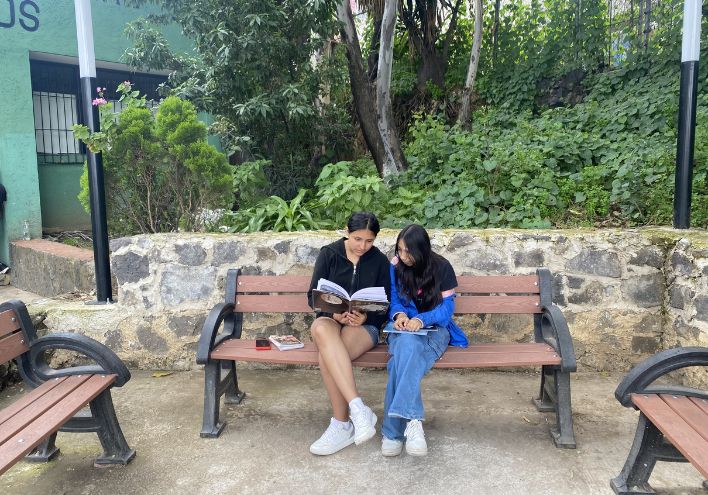
The ATD Fourth World community library in Mesa de los Hornos, Mexico City, has been opening its doors to the community every week for over a year. It’s a place where you don’t need to be a confident or habitual reader, and there’s no need to bring an ID or meet any requirements. You can simply come in and spend some time there — whether reading quietly, chatting and sharing stories, or enjoying a board game. But once you walk through the door, something shifts: time slows down, people can begin from wherever they are, at their own pace, and no one is judged.
In a neighborhood where daily life means always being on your guard, the library has become a calm, welcoming space — somewhere people can focus, rest their minds, let their imagination roam, and build a sense of community. “When I’m reading, I feel calm,” says Paty, an 11-year-old reader. “This is a place where people get along, a place of peace and quiet,” she continues. “Books are… how can I put it? They’re like toys — but in a good way, a healthy way.”
For many people, reading — or being surrounded by books — is a way to momentarily step outside the constant survival mode that poverty forces on them. “Getting lost in books is a really beautiful thing; it helps you not to constantly think about the difficult things we go through,” says Ernestina, a woman from the neighborhood who came to reading later in life, but with great enthusiasm.
“I only started reading when I started coming to the library. I finished primary and secondary school at 55 years old, alongside my mother, who finished at 80. The workbooks they gave us were the only things we’d ever really looked at. I’d never had the chance to read a whole book or visit a library. I’d heard about kids going there to do homework and look for books, but I’d never once set foot in one.”
Ernestina, reader
More and more readers
Since it opened, Ernestina has visited the library every week with her grandchildren, ages 15 and 11. Between the three of them, they’ve already borrowed more than 80 books and read many others during long afternoons at the library. Like them, many others are discovering the joy of reading freely, but with support around them.
Thanks to word of mouth, the street library that takes place fortnightly, and the team’s ongoing efforts to promote reading — going out into the streets, walking around the neighborhood, knocking on doors, and taking part in community events to spread the word — almost 300 people of all ages now hold library cards. Each Wednesday, the library welcomes between 15 and 30 readers, with many more joining on Saturdays and Sundays when special activities are organized.
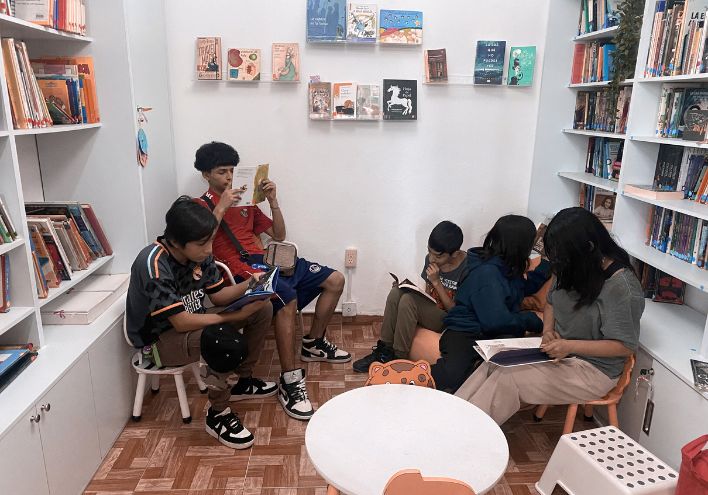
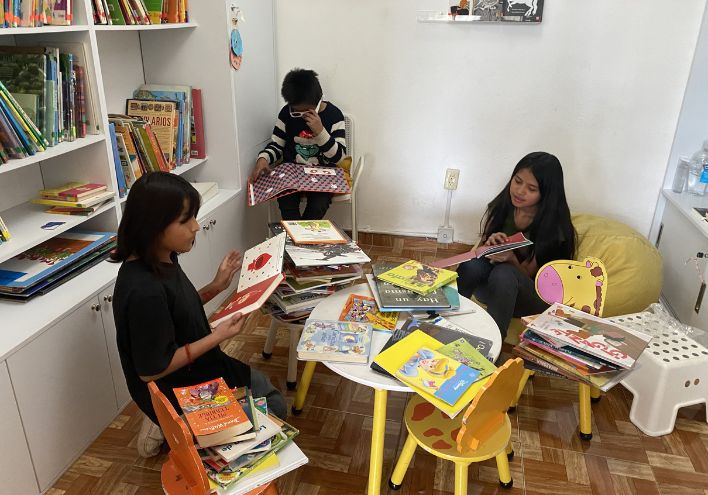
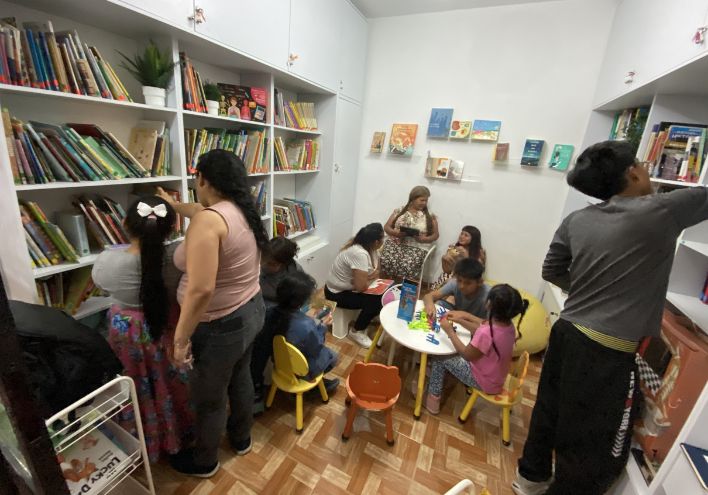
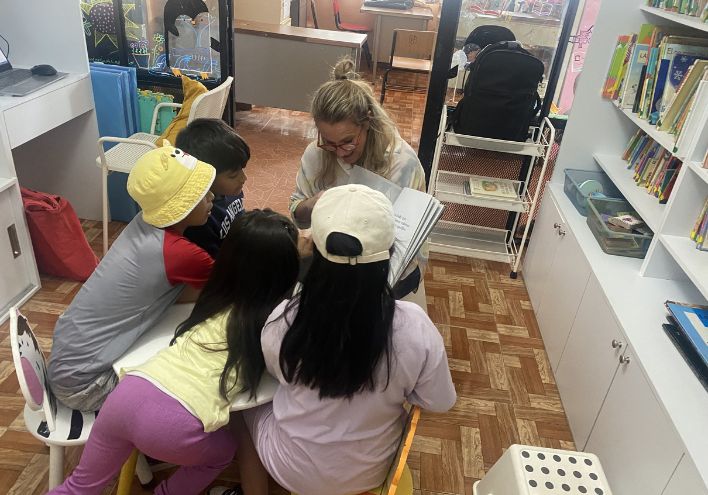
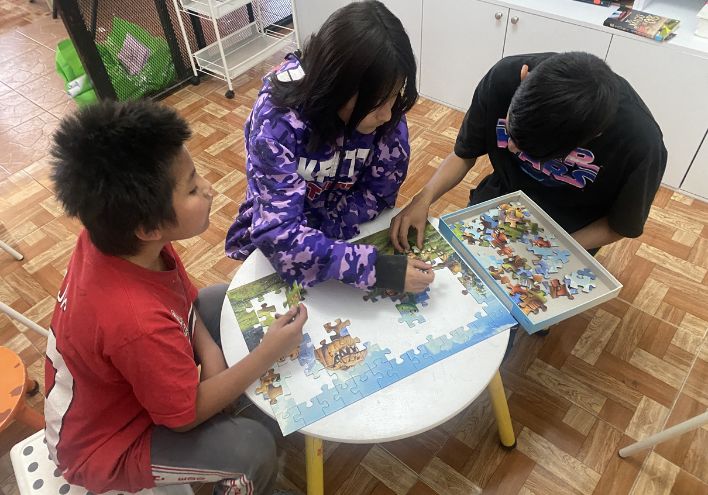
The space is small — a storage room inside a local sports center, renovated by a group of young people from the neighborhood — but it brings together people of all ages: children, teenagers, parents, and older adults. Some read, others play. At one table, a puzzle is being assembled; at another, a group of teenagers quietly turns pages; nearby, a mother reads one of her first books to her baby.
The collection and reading facilitation
“Even though they bring their own stories, memories, and ways of engaging with words, people who come through our doors often don’t think of themselves as readers,” explains Beatriz, one of the librarians. “Some never had books at home, or feel that reading is a chore — something you’re made to do at school. Others only learned to read as adults. Others stopped years ago because they didn’t have the time — work and other concerns took over. Here, none of that matters. Reading isn’t something we expect from people — it’s something we do alongside them.”
“Making readers,” she continues, “often starts with reading together. For a young child, getting into a story is just as important as the bond that forms around it, because growing up well and feeling secure has a lot to do with feeling supported. I see this every week in the library, just as I did as a mother.
“I think, for example, of Carlos, a 14-year-old, and the time he read The Wizard of Oz. For weeks, he read the book at home and brought it back to the library to share it with me. He’d tell me what had happened, we’d read a few pages aloud, we’d get caught up in the story together, and then he’d take the book home again until the next time.
“One day, he wrote to tell me he’d be coming to the library so we could read together. I explained that I couldn’t be there that week, but he could carry on reading with someone else on the team. His reply really surprised me: ‘Yeah, that’s fine… but I’d like to finish the book with you. A few months ago, I was reading The Canterville Ghost with Jimena, but one day she couldn’t come, and I read it with someone else. I finished it, but it wasn’t the same.’”
This small story shows that beyond methods — which do matter — the real key lies there: reading together, choosing books carefully, and creating a space where reading becomes a way to experience connection, shared emotion, and the value of feeling heard and seen.
The library’s collection is designed to support new readers of all ages. It includes illustrated books for children and adults, short stories that let people finish a book for the first time, novellas and comics that spark interest in fiction, brief essays on topics that matter to the community, and some classics that still speak to readers today.
The idea behind the collection is simple: everyone should be able to find a book that feels right for them — one that isn’t intimidating, that sparks curiosity, and that makes it possible to connect with reading in a way that feels enjoyable and safe. It’s not just about reading more, or even reading “better” for its own sake, but about finding books that speak to each person’s experiences, questions, and ways of expressing themselves — and to the community as a whole.
Books are at the heart of it all, but the library works because there’s real, ongoing support as well: someone who helps you choose a book, checks in if you haven’t been around for a while, asks what you think, remembers what you were reading, and suggests something that might be right for you. Sometimes they read to you; other times, they read with you. Other times, they simply listen.
That steady presence acts as a bridge. Reading stops feeling lonely or intimidating and becomes a shared experience. And that support doesn’t just come from the team — it flows between mothers, fathers, children, and young people who read to each other, listen to each other, and support one another.
“When a mother comes to read with her children, she takes center stage in the reading experience; she gradually learns to serve as that bridge, to know what questions to ask and how to draw the child into the book.”
Beatriz, reading facilitator
Running a community library also means going through moments of uncertainty. There are weeks when, for no clear reason, nobody shows up — but the library stays open. Someone is there to tidy the books, send a few messages to regular readers, and wait. The following week, you try again.
To help keep those connections alive, there’s a WhatsApp group where people share recommendations, new releases, and sometimes audiobooks. Perseverance is a part of the work. Showing up, providing a judgment-free opportunity, and trusting that, sooner or later, people will come.
Impact
“Of course a book can change someone’s life!” replies Pascuala to a question posed by Natalia and Emilio, young allies working at the street library who conducted the interviews for this article.
“When you read with attention, sometimes you see yourself reflected in what you’re reading. There are moments where you think: that’s happened to me, this is exactly what I’m going through.”
Pascuala, reader
“I grew up in poverty and didn’t go to school,” says Pascuala. “I learned little bits here and there because other people taught me — not teachers, but people who helped me learn to write my name and the basics. I started working when I was very young, and I never had books, not even school ones.
“I’m 51, and I only learned to read recently, at an adult education center. Now I borrow books from the library, and as I read, I’m learning how to spell words and how to leave spaces between them. I read at night, after I’ve finished all my chores and the house is quiet. That’s when I enjoy reading the most, because I’m at peace and can really focus on what I’m reading.”
For many adults, this process has profound effects. Reading doesn’t just expand your vocabulary or improve your writing — it restores confidence and broadens horizons. Being able to read a document, sign your name without hesitation, or navigate public transport without fear of getting lost changes how you see yourself. The library becomes a space of dignity and autonomy. These personal changes don’t remove structural barriers, but they do strengthen people’s ability to claim their rights, navigate public spaces, and participate more confidently in society.
For children, the impact is different, but no less significant. When they have a space where books are within reach — where reading isn’t an obligation but a pleasure — they grow up recognizing themselves as readers from an early age. In the library, they learn to focus, to listen, to choose, to finish one story and begin another.
They gradually gain confidence, their reading improves little by little, and above all, they discover that books can be a place of refuge, imagination, and connection. That early experience leaves a lasting mark: reading is no longer distant, but something that belongs to them — something they can always come back to.
“I’d love there to be lots of free spaces where people could get into reading, and where other kids could enjoy it as much as I do. Games often turn into a competition about who’s best. But we don’t read books to see who reads the most — we read to share.”
Paty, 11-year-old reader
The library’s impact can’t be understood as a standalone solution to poverty, but rather as part of a broader web of much-needed educational and community efforts. It’s a long-term project, whose impact will unfold over time.
Even so, there are already signs of the difference it is making: children who come back every week, young people who bring their friends, readers who call to ask for specific books or recommend them to others, adults who return to reading, and mothers who bring their children — even babies — hoping they will grow up loving books.
“I’m a mother of two boys. I feel so happy because I’ve always wanted my children to engage with culture, and thanks to this library, they’ve learned so much. They’re starting to enjoy reading — they don’t look at books with indifference anymore, but with excitement, eager to discover something new.
“My four-year-old even picks out his own books, which I love. The library is in a very disadvantaged area, and it’s encouraging to see so many children and young people discovering reading and building a love of culture here in our neighborhood.”
Mayra, reader and mother of young readers
Thinking of the library as a community space also means asking about the people who don’t come in, who don’t stay, or who don’t come back — and about the barriers, visible or invisible, that remain. This means constantly reflecting on the work and finding ways to reach those who are not yet included.
A Better Future
The community library grew out of more than thirteen years of street library work in Mesa de los Hornos. From those weekly gatherings, a permanent space has emerged — cared for and open — where reading, play, reflection, and tranquillity coexist.
In a neighborhood marked by poverty, a library sustained by readers, facilitators, and families is much more than a space with books: it’s a place where rights are rebuilt, community life is strengthened, and educational horizons are opened.
Book by book, encounter by encounter, the library becomes a concrete tool — limited, but necessary — in the struggle against poverty and exclusion. It’s a tool that helps people to see themselves as someone with a voice and ideas of their own — an active member of society, with the right to give and receive, and to build a better future for themselves, their community, and the world.