


No Child Should Be Invisible
On March 2, 2026, ATD Fourth World participated in a side event at the United Nations Human Rights Council. Also taking part were UNICEF and the African Committee of Experts on the Rights and Welfare of the Child. The discussion explored how digitalisation can support every child’s right to a legal identity, while ensuring that the most vulnerable are not excluded.
For over sixty years, ATD Fourth World has worked alongside children and adults living in extreme poverty to ensure their voices shape the policies that affect their lives. Families repeatedly stress the importance of birth registration, often described as a gateway to rights such as education, healthcare, and social protection.
Yet for many families, registering a child remains extremely difficult. Systemic barriers, including transportation costs, long distances to administrative offices, lack of information, and fear of administrative mistreatment, often prevent parents from completing the process.
In the Central African Republic, ATD Fourth World works with communities to address these challenges. In Bangui, ATD supported the creation of Administrative Documents Commissions in twelve neighbourhoods. Working with children and adults, traditional birth attendants, local authorities, neighbourhood leaders, the national civil registry, and CIVIPOL, these initiatives helped 245 children obtain birth certificates.
Children themselves have also been actively involved. Members of the Tapori Children’s Parliament in Bangui raise awareness, support children in obtaining birth certificates, and encourage adults to register births.
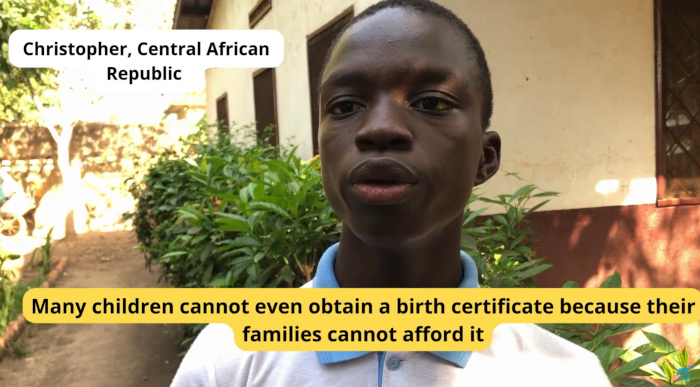
During the event, Christopher Dewane, a member of the Tapori Children’s Parliament, shared how digitalisation can both help and exclude children:
“When I heard the word ‘digitalization’ for the first time, it seemed very complicated to me, almost inaccessible. It feels far removed from our reality, especially for children living in villages.”
He explained that many families lack access to computers, the internet, or even electricity.
“Many children cannot even obtain a birth certificate because their families cannot afford it. Yet without a birth certificate, a child cannot go to school or pursue their dreams.”
At the same time, digital records could help protect children’s rights by ensuring documents can be recovered even when physical copies are lost.
You can find Christopher’s video on ATD Fourth World’s YouTube channel.
Ultimately, digitalisation offers opportunities to make birth registration more accessible, but only if systems are designed with the participation of the most vulnerable families. One promising approach is to bring registration services closer to communities.
Midwives, traditional birth attendants, and other trusted community actors could be equipped with simple digital tools to help register births directly within communities or through local health systems.
By working together with families, local authorities, and community workers, digitalisation can strengthen civil registration systems while ensuring that no child is excluded. For ATD Fourth World, the priority remains clear: digitalisation must serve dignity, inclusion, and human rights so that every child is recognized and no child remains invisible.