


The Determination of Women in the Democratic Republic of the Congo

A year of upheaval in daily life
For some months, a humanitarian crisis has been severely disrupting the lives of people living in the eastern portion of the Democratic Republic of the Congo (DRC). For more details about this situation, we encourage you to read this article on the ATD Fourth World website.
Since 14 February 2025, when anti-government forces of the March 23 Movement (M23) occupied part of the South Kivu Province, living conditions have significantly deteriorated. The most marginalised families have faced increasing hardship due to difficulties in accessing fields and markets, rising food prices, population displacement, and cuts to essential services.
Yet life goes on despite these challenges. Every day, the women get up, organise their household, look for solutions, improvise, and adapt to protect their children and provide for them. Their determination, renewed every day yet often overlooked, is one of the pillars of community resistance.
Low-key but decisive
What is happening in South Kivu today reveals a profound truth: resistance does not necessarily involve big, bold initiatives. It is expressed in small acts of everyday life.
It is found in a meal that is shared despite food shortages, an activity started over despite losses, a helping hand offered to a neighbour, or a child encouraged not to give up.
Women living in poverty do not define themselves solely by the difficulties they face. They are also agents of change and the backbone of their communities. Their ability to adapt, organise, and keep going, even in times of upheaval, helps sustain the community.
And on the route they are tracing, despite the uncertainties, the future is already taking shape.
Women at the centre of daily survival
In their extremely dangerous surroundings, women emerge as the main guarantors of their families’ survival and, beyond that, the continuity of community life.
Their role is not limited to support: women provide, organise, and manage the basics of everyday life, often under harsh conditions.
In Bukavu and the surrounding area, the subsistence economy depends largely on their activities. Even before the recent upheavals, many women already made a living from small-scale trade, subsistence farming, or informal work. Today, these livelihoods have been severely disrupted. People have difficulty getting to their fields, especially in outlying areas such as Kabare, Walungu, and Mudaka. Roads are less accessible and travel is more dangerous. And still some women continue to make the journey, sometimes undergoing a long, arduous trek, to farm or bring back a few items their families need to survive. Others, who used to make a living from small-scale trade, are faced with a shortage of goods and higher prices. Basic necessities are hard to come by, and the families can no longer afford their household needs. Despite this, women continue to sell, barter, and make adjustments, often cutting back on their own needs so they can meet those of their children.
We often hear the same thing:
“We make do with what we find. Even if it’s not much, we have to share and hang on.”
Women’s determination to help their families survive
Women who have been displaced, mainly from places like Minova and Kabare, arrive in Bukavu after being forced to leave their villages under harsh conditions. Many have left behind their fields, their belongings, and everything important to their lives. They must start over again while grappling with the trauma of what they have been through.
They quickly set about rebuilding their livelihoods, looking for odd jobs, joining self-help groups, or starting small-scale trading activities. Their priority is always the same: to feed their children and maintain a minimum level of family stability.
In the working-class neighbourhoods of Kadutu, the town’s main market has been damaged, devastating economic activity and reducing the income sources of many of the women. But some are trying to gradually reclaim their place in the commercial networks, albeit on a small scale.
In this context, daily life becomes a constant balancing act. Women have to feed and protect their families while coping with scarce resources, the rising cost of living, and the dangers of moving around.
Often under extreme pressure, they have to make difficult decisions, such as selling some of their remaining belongings, cutting back on meals, and putting their own needs on hold to prioritise their children.
Another important role women play is related to health. With healthcare structures often overwhelmed or hard to reach, pregnant women face major obstacles to giving birth safely. Others have to care for sick children where healthcare resources are limited. Despite these challenges, women continue to support and look after their families.
Strength in numbers
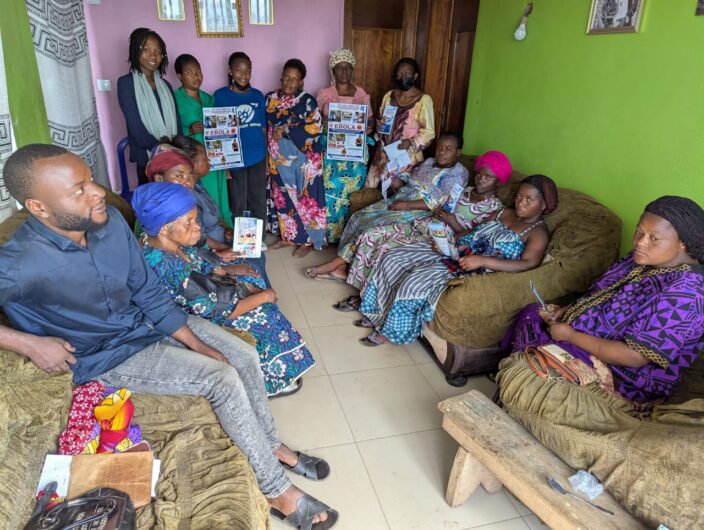
The women are not leaving each other alone to face these difficulties. In several communities, local organisations still exist, and in some cases they have become stronger. They include AVEC groups (Village Savings and Loan Associations), solidarity groups formed to deal with emergencies, and mutual help networks among neighbours, families, and friends.
These structures make it possible not only to raise small amounts of money, but also to share the burden, offer moral support, and look for solutions together. When a woman falls ill, when a child needs care, or when someone dies, these networks play a key role, becoming a safety net in a situation where there is little formal support.
One participant in a savings group said:
“Alone, we are weak. Together, we find the strength to move forward.”
Because many formal structures have been weakened, these women-led initiatives help keep society together. They create support systems where there are few to fall back on.
In this way, despite the difficulties, women continue to feed their families, pursue economic activities — however precarious — and maintain some forms of collective organisation.
Their daily efforts may be low-key, but they are decisive. It is the women who cope with emergencies and maintain a certain continuity in family life. As one participant in a community group pointed out:
“We can’t stop. If we stop, everything stops with us.”
Safeguarding children and protecting the future
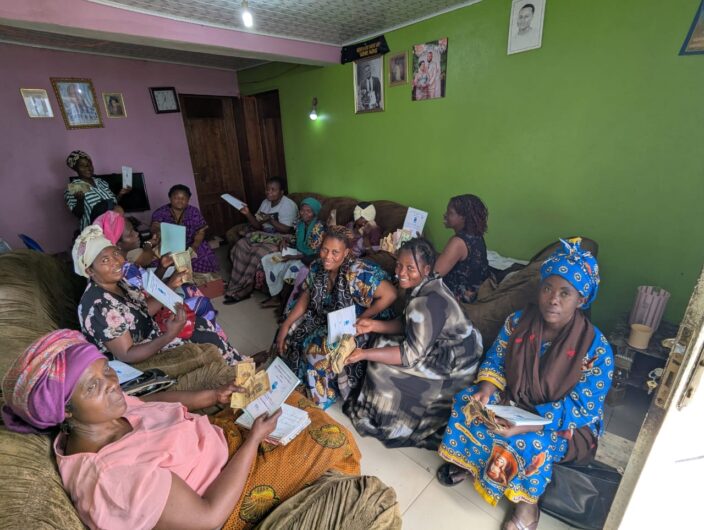
With everything the women have to endure, the one constant is their focus on their children’s future. Even when the children’s education is disrupted, it remains a priority. Many mothers try to maintain a sense of structure, to pass on values, and to encourage their children to learn even though schools are closed or inaccessible. They know that education is more than gaining knowledge: it is a chance to escape the cycle of poverty.
In addition, the mothers try to safeguard their children’s emotional well-being. In their stressful, unstable environments, they try to maintain a sense of stability for their children, to reassure and protect them. One mother said:
“We can’t control everything, but we can give them the strength to carry on.”
Without fanfare, they organise their families’ lives to counteract the upheavals they cannot control and create some continuity for their children.