


Creating a New Space for Young People
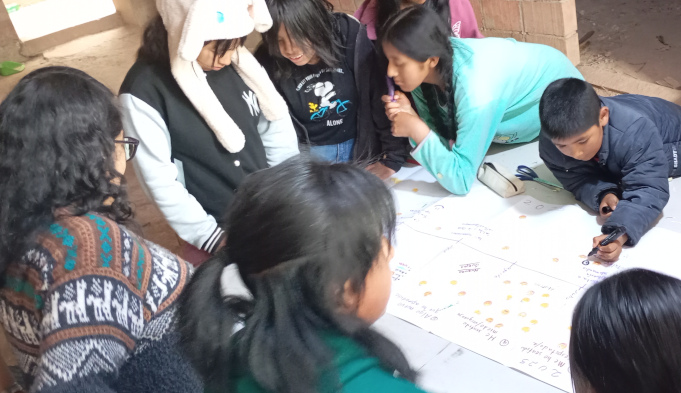
At ATD Fourth World Peru, we are driven by the same promise that guides ATD Fourth World around the world: to leave no one behind. Following our 2024 evaluation and program review, we identified four key priorities: training for all members, social and environmental justice, advocacy and mobilization, and quality education. Two cross-cutting themes guide our efforts: poverty and gender, and youth and adolescence.
We have been working with children from Cusco and the Cuyo Grande community for many years through our street libraries and book-lending programs. We have also worked with adults from these communities through family visits and by creating spaces for reflection, such as the Fourth World People’s University. However, we realized that a significant segment of these communities had not yet been engaged: adolescents aged 12 to 17. This realization prompted us to take action.
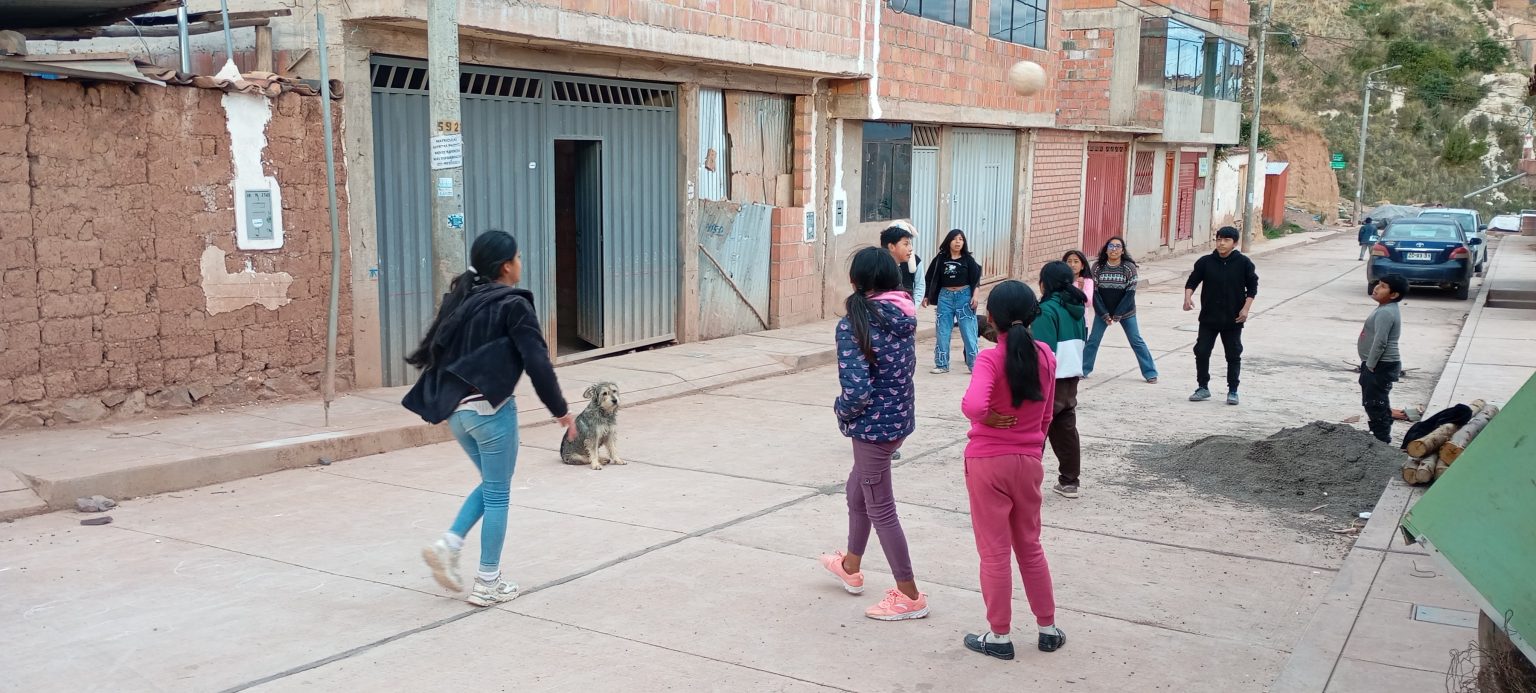
Listening in order to act
As we listened to parents, a common set of aspirations emerged. They wanted their children to have the confidence to express themselves without fear, communicate at school and with other adults, make positive life choices, and have a brighter future than their own.
“It would be good to do things they like, so that they are motivated, because if not, it’s not going to work” — A father of two teens in Cusco.
“I want my daughter to take part, so she performs better at school. […]. Sometimes young people struggle to speak in front of their class, so I want her to learn to be unafraid.” — A mother of a teen in Cusco.
These words prompted us to create a new space, specially designed for youth.
We made a list of young people to invite, while recognizing that participation would not be equally accessible to everyone. Many are responsible for essential household tasks, including preparing meals, washing clothes by hand, caring for younger siblings, and contributing to the family’s income by helping sell goods. Some have too much schoolwork or attend private academies (paid for through their parents’ hard work) to improve their grades and to better prepare them for university. Despite all these limitations, fifteen teenagers participate in this program.
This group meets every Saturday from 3:00 to 5:30 pm in the Moises Barreda neighborhood in the district of San Sebastian in Cusco.
A space created in collaboration with allies
This initiative was developed in collaboration with the Sipas Wayna program, which is named after the Quechua words for “boys and girls.” We are assisted by Karely Paredes, an ATD Fourth World ally, who works with this program. Her experience and ability to connect with teenagers have been key in creating an atmosphere of trust and respect within the group. As part of the program, we offer improv and capoeira workshops.
Two student interns from the Saint Anthony University of Cusco have also become involved in the initiative. We hope that with their support, this space will shed light on the challenges faced by many teenagers who lack access to cultural or recreational opportunities in their own communities. We also hope that later on, other ATD Fourth World allies will be able to take part in this space.
A place to grow and discover
 Our main goal is for young people to recognize their own strengths and creativity, and to see that their ideas and perspectives have value both within their communities and beyond. We also want them to know and value their city, a quintessential tourist and cultural destination, but one that seems far off to them for economic, geographic, or even symbolic reasons. The first step in achieving these goals is to build their confidence.
We aim to create opportunities for young people to connect with other groups. This includes the group in Cuyo Grande, where we are already collaborating on environmental protection issues, as well as other young people from the Sipas Wayna program. We hope that through activities, young people will discover that although they come from different backgrounds, they also have much in common.
Accompanying families
Another key aspect of this initiative is building trusting relationships with families through listening to their concerns and learning about their aspirations for their children. Together, we want to create spaces where parents’ dreams can come true through small but significant actions that strengthen familial and community relations.
We know that many of these young people live in complex and sometimes very difficult circumstances. Several have experienced mistreatment at school or faced discrimination on public transport. As such, we believe it’s very important to stay close to them, listen to them, and support them so they can grow with confidence and learn to defend themselves and their rights.
Incorporating their valuable ideas
Before we invited the young people to take part, we asked them what they’d like to do in this new space. Initially, they were quiet, possibly because it was all new to them. But after almost two months of meetings, more opinions, ideas, and suggestions emerged about what they wanted to experience together.
“The first time I came, I played cards with Ms. Carolina and two other girls. It was very fun, and I learned a new game”
This account shows us that games are not only fun but also a way to learn and interact with one another. There were also moments where the teens felt challenged or annoyed:
“We came today to have fun, but I got stressed out…”
“I don’t want to come because I’m scared they’re going to laugh at me because I’m small.”
This reminds us that the group provides a space where they can express their feelings, even when it’s not easy. It also proves the importance of continuing to build a safe space where everyone feels accepted.
We also observed how academic pressure affects their participation:
“This is really only for students in their first and second years of high school, because the rest of us are busy with college-prep classes.”
All these considerations help us to better understand their reality and adapt the space to their expectations.
We know this is just the start. But we believe that when young people find a space where they can speak, be heard, and dream together, something meaningful begins to emerge, and that in itself is an achievement.