


The Effective Participation of People in Poverty in Beyond Growth Strategies
How can we make economies more inclusive and sustainable by design?
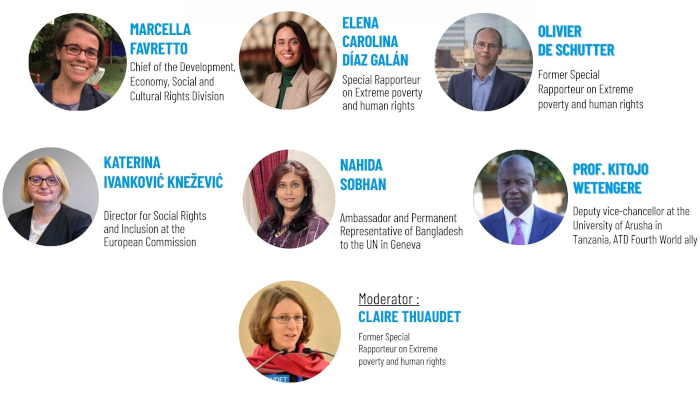
This question was central to the 62nd HRC session at the United Nations in Geneva, co-sponsored by members of the core group of the resolution on extreme poverty and human rights: the Permanent Missions of Albania, Belgium, Chile, France, Morocco, Peru, the Philippines, and Romania. Claire Thuaudet, Deputy Permanent Representative of France to the UN in Geneva, moderated the session on behalf of the core group.
During the session, ATD Fourth World organised a side event entitled “The effective participation of people in poverty beyond growth strategies.” The side event followed the publication of the latest report by the former Special Rapporteur on extreme poverty and human rights, Olivier De Schutter. In the report, “A Roadmap for Eradicating Poverty Beyond Growth,” De Schutter details several key policies that highlight the role of lived experience in designing tools to develop global anti-poverty strategies. The new Special Rapporteur, Elena Carolina Díaz Galán, presented the report during the session.
A forum on inclusive policies and progress towards Sustainable Development Goal (SDG) 1: “End poverty in all its forms everywhere”
The event centred on the role of people in poverty in anti-poverty strategies that produce real social change. Emmanuel Reynaud, ATD Fourth World Representative to the United Nations in Geneva, emphasised:
“[…] people living in poverty should not be taken as victims or as beneficiaries but as experts of poverty. They are the ones who know best what it means to live in poverty and should be involved at all stages in reflection or implementation of policies […].”
Moreover, efforts to eradicate poverty must be rooted in human rights and dignity, while also addressing social exclusion and institutional maltreatment. To do so, Reynaud presented the organisation’s methodology and broader action against extreme poverty, centring on ATD Fourth World’s Merging of Knowledge approach. This methodology brings people with lived experience of poverty together with people from different backgrounds, such as academics, and practitioners, and reunites them around a policy issue to “merge their knowledge” and help create inclusive, participatory policies.
Reynaud also highlighted the Inclusive and Deliberative Elaboration and Evaluation of Policies tool (IDEEP), developed jointly by ATD Fourth World and De Schutter and specifically designed to include the participation of people in situations of extreme poverty. The tool was an inspiration for the section in the report: ¨Democratic Planning and Governance” which is ¨not an additional pillar but a transversal framework that underpins and enables all five policy areas¨ mentioned in the document.
Partners support ATD Fourth World’s approach
Other voices also addressed this approach throughout the event. Marcela Favretto of OHCHR took the floor, stating
“participation [must be thought] not as an add-on but really as a fundamental element to dismantle social exclusion and ensure that anti-poverty strategies respond to real needs.”
Another speaker, Permanent Representative of Bangladesh H.E. Nahida Sobhan, highlighted the country’s efforts following the recommendations from the former Special Rapporteur’s visit: “Over the decades, Bangladesh has demonstrated that sustained economic growth combined with strategic investments in education, health care, women’s empowerment, food security, and social protection can transform the lives of millions. These experiences have reinforced our conviction that development succeeds only when people are placed at its centre. At the same time, our government recognises that poverty extends beyond the lack of income. It often reflects deeper structural barriers that prevent people from participating fully in economic, social, and public life. Addressing these barriers requires inclusive institutions.”
Katarina Ivanković-Knežević, Director for Social Rights and Inclusion at the European Commission, shared key points of the EU’s first anti-poverty strategy, which aims to end poverty by 2050 through an approach that supports people at every stage of life while actively combating stigmatisation. She emphasised, “The effective participation of people experiencing poverty is crucial if we are to make progress in the prevention and reduction of poverty.” This strategy includes a dedicated social package, notably focused on housing exclusion, and ensures that people living in poverty are considered at all levels of policymaking. She also highlighted ATD Fourth World’s role, noting that the Merging of Knowledge approach shaped the creation of this strategy.
The last speaker, Olivier De Schutter, also underscored the importance of people participating in decisions that affect them. He stressed that participation means more than consultation. Solutions should be developed with people who have lived experience of poverty, drawing on their knowledge and proposals, stating: “Participation is co-construction.” He also highlighted the importance of the SDGs, particularly SDG 13, which addresses climate change.
This event demonstrated ATD Fourth World’s commitment to eradicating poverty by providing the tools and methods that support effective participation. Participants agreed that eradicating poverty requires more than economic expansion; it requires structural change, the redistribution of power, and the recognition that people with experience of poverty are neither beneficiaries nor victims but essential partners in designing meaningful solutions.