


Tribute to Gabrielle Erpicum
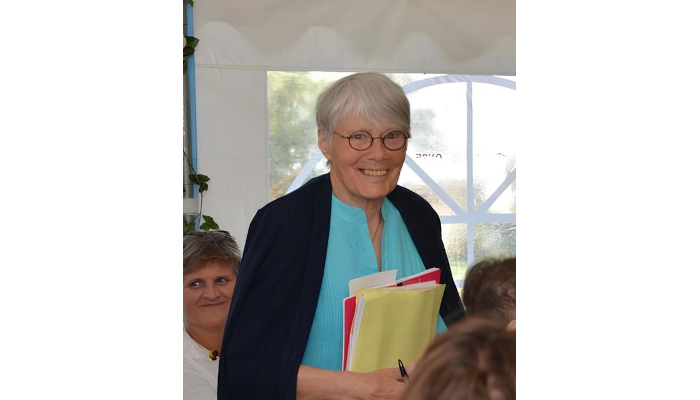
On the night of Thursday, 26 March 2026, Gabrielle Erpicum died. It was sad for everyone who knew her. The many messages we have received from around the world have shown us the strength of the bonds Gabrielle forged throughout her life.
Gabrielle was born in Uccle, Belgium, in 1938. She was one of the first people to join Father Joseph Wresinski in 1962 at the emergency housing camp in Noisy-le-Grand, near Paris, a place in the middle of nowhere where families stripped of everything had taken refuge. She was 25 at the time, with a deep Christian faith instilled in her by her family, experience with the Girl Scouts, and a great sensitivity toward others, especially the most marginalised people.
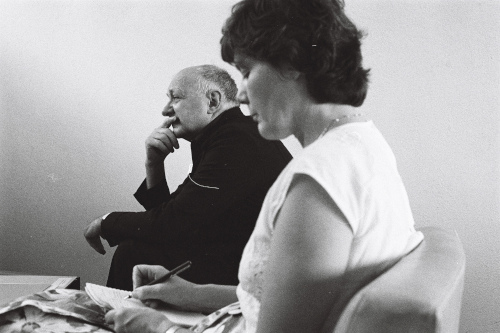
Many came to the camp, but few stayed. It took inner strength and courage to live there. Gabrielle left behind a family, a life that offered her security, and a bright future that was assured for her. No one really understood her choice — neither her family nor her friends.
She returned to Belgium for a few months, where she mobilised her parish and compiled what would become ATD’s first mailing list in Belgium. But she remembered the children’s smiles and energy; she couldn’t abandon them, and they drew her back to Noisy. There she bonded with the young people, especially the teenage girls — so vulnerable and yet so strong — with whom she would maintain ties throughout her life.
It took courage to hold firm at a time when nothing existed yet except in Father Joseph’s vision, in his confidence that men and women could connect with the hopes and struggles of these families. Along with other people, Gabrielle sensed, almost intuitively, that a historic moment was unfolding with Father Joseph that would change the world. It was there that she took up the daily practice of writing to share in the families’ experiences, to understand them in their humanity, and to love them.
Every morning Father Joseph met with these first volunteers, with whom he conceived and shaped his vision of liberation. This small team convened formally for the first time in 1966 in Houlgate, France, to write a founding text of our movement, the basic principles and objectives. Later, they met again in the Black Forest region of Germany and would come to be known as the Black Forest group.
Three years after Gabrielle arrived at the camp, Father Joseph asked her to help him set up our movement’s first secretariat. She understood the urgent need to raise awareness of the daily struggles and hopes of the families in the camp through letters that would engage and touch people. Throughout her life, Gabrielle retained this eagerness to communicate through the art of letter-writing. Many of the messages we received mention a letter, a note, or a card from Gabrielle that the recipient has treasured.
Gabrielle became Father Joseph’s daily collaborator, the person who welcomed with a warm smile everyone who came to see him, who put them at ease, inspired trust, and made them feel valued.
She would improvise a meal when the conversation ran late.
She would rewrite by hand once, twice, and three times the talks that Father Joseph kept tweaking right up until the last minute.
She was his driver, taking him to all his meetings and appointments.
She prepared for and accompanied him on many of his journeys when he went to learn about the neglect and destitution of men, women, and children around the world.
She gathered Father Joseph’s notes, written on small scraps of paper, or pulled a tape recorder from her bag so as not to lose any of his remarkable insights as they unfolded and developed day by day. We owe it to Gabrielle for having preserved so many meetings, lectures, and homilies; for having known that future generations would need them.
She was always present to support her co-workers when they were discouraged. How many people owe it to her that they stayed or returned after going through moments of doubt?
She was attentive to events in everyone’s life — their troubles and losses, and also their joys (the births, the children) — always offering care and kindness.
Gabrielle worked tirelessly to make Father Joseph’s daily life possible. We admired her patience and her trust in the man who opened our eyes to what gives meaning to a just and caring life together. We find it hard to separate Gabrielle from Father Joseph, and yet she was not his shadow; their influence on each other was mutual. She remained true to herself, with her creativity, her sensitivity, her appreciation for beauty, and her exceptional ability to connect with other people.
Gabrielle was both a witness to and a key player in our movement’s defining moments. Full of ideas and initiative, she often contributed to those moments. We remember that while traveling alongside a renowned designer, Gabrielle spoke to him about her work. She later put him in touch with Father Joseph, and it was with that designer that the commemorative stone took shape, the stone that was inaugurated on 17 October 1987 at the Plaza of Liberties and Human Rights at the Trocadéro in Paris. It affirms, for the first time in history, that poverty is a violation of human rights and that uniting to overcome it is a solemn duty. Gabrielle never lost any opportunity to benefit our movement.
In 1989, to fulfill the promise Father Joseph had made to the families in Noisy-le-Grand — “I will lead you up the steps of the Élysée, the United Nations, and the Vatican” — Gabrielle ensured that a delegation of 350 ATD members from all over the world met with Pope John Paul II at Castel Gandolfo in Italy. Each delegation brought a small amount of soil from places of poverty. All this soil is now mixed together in Méry-sur-Oise, nourishing a cedar tree opposite Father Joseph’s grave.
From the very beginning, Father Joseph entrusted Gabrielle with welcoming newcomers to the camp — often young people with varied motivations. He often had discussions with her about the meaning of what would become the volunteer corps and the forms it might take. Gabrielle played a particularly important role in building this volunteer corps. She was always determined that today, tomorrow, and the day after, men and women would reach out to the most forgotten individuals and families to build with them a world where poverty would no longer exist. She knew that to achieve this, it was essential to have a volunteer corps that was available and committed to the long term. This international volunteer corps, which in the 1960s seemed like a utopian dream, has become a reality, and Gabrielle nurtured and supported it from the beginning.
She knew that every member of the volunteer corps must find their own personal path. She knew what it was like to be far from family, to leave a career and the security it provides, to live without being fully understood. She tried to make sure that every volunteer corps member could be part of a small team that nurtured a sense of responsibility, where they could be supported and support others. How many times she would ask, “Is this person happy?”
After so many years working alongside Father Joseph, Gabrielle was deeply influenced by the path he took and by his vision of a different, better world.
It was to Gabrielle, Claude Ferrand, and Eugen Brand that Father Joseph entrusted “the house”, as he put it, before he died. Though their sorrow was intense and the challenge enormous, all three took on this first collective leadership of our movement, continuing to bring projects to fruition, continuing to welcome and train new generations of dedicated people, and continuing to build our movement’s unity while respecting its diversity.
Then, after five years, they stepped away to allow ATD Fourth World to gradually develop a new form of governance after losing its founder.
Gabrielle, moved by the lives shattered by the genocide in Rwanda, went to Kenya for a time, where she worked with an organisation that welcomed and supported refugees. She was confident that the cause of the most marginalised people, which she had carried with her for years, could open a path of hope for the refugees.
Back in France, Gabrielle helped set up the Joseph Wresinski Archives and Research Centre in Baillet-en-France. With a few other people, she gathered, sorted, and organised the archives. Determined that nothing should be lost, she even preserved documents that had been partially burned in one of the fires at the Noisy-le-Grand camp. It was a colossal undertaking that today allows us to explore the rich life of the man who revealed to us the suffering and strength of a people, ensuring they would no longer be forgotten by history but would become the catalyst for a new society. Who better than Gabrielle could have grasped this profound truth present in Father Joseph’s heart, mind, and deeds? In 2023, these archives were inscribed in the UNESCO Memory of the World Register as part of the world’s documentary heritage.
This legacy is particularly precious for people who have had to face the contempt of others. One of them addressed Gabrielle in a letter she sent to us: “Thank you for helping us learn about Father Joseph through your words, your acts of love, and your eagerness to learn from others. Thank you for all the time you have devoted to me, for this time allows me to stand tall, head held high, proud of my origins, my eyes turned toward my people so as not to ignore them, strengthened by the knowledge from experience that poverty does not define who I am, and happy to have shared this journey with you; for despite so much suffering, it is also so beautiful. Being a Fourth World activist is the most beautiful gift you have left me.”
Gabrielle wanted us never to forget the origins and core principles of our movement. Everyone must be able to find strength there to move forward and deepen their involvement. By reaching out to young people — children and friends of allies — she created a space in Méry-sur-Oise that is open to all called “We Are Heirs”, acknowledging the leaders who came before us and on whose legacy we have built.
With two young volunteer corps members, she worked on the messages she had written and sent out four times a year to rally support. In 2021 they were published in a book entitled Des Vies Partagées (Shared Lives). Each of the messages reveals a truth drawn from lives that are rarely seen, that some people hold in contempt, and that others ignore. Gabrielle saw in them nuggets of humanity that surprise us, move us, and stay with us for a long time. An ally writes: “How much her quarterly messages have meant to me as an ally. They were never pessimistic; on the contrary, Gabrielle elevated the family’s story to the level of the great history of humanity — so rich and diverse — bringing it into our community. She had the talent, even as she recounted episodes of political and social struggle, to draw us into the life of the family she was describing. It was full of emotion and insights.” In the spring of 2003, Gabrielle ended her message with these words, which still ring true today: “Let us continue together to say yes to everything that enriches humanity, so that we never lose hope in goodness and never lose sight of the profound meaning of our presence on the Earth.”
Until the very end, Gabrielle maintained her boundless enthusiasm.
One place was particularly close to her heart: the chapel Notre Dame des sans-logis et de tout le monde (Our Lady of Homeless People and of All People), built in the centre of the Noisy-le-Grand camp by the men who lived there. She poured all her energy into having it renovated and listed as a historic monument. Since it was built, this place has welcomed people abandoned and mistreated by society; and there they express their faith and their longing for justice and mercy. Couples have been married there, children have been baptised there, and funerals have been held there. Gabrielle was determined that the dignity of the most excluded people continue to be revealed there. For the re-inauguration of the chapel, she made every effort to find children and young people who had lived in the original camp. She had kept in touch with some of them, but not all. Now adults, they had to be the first to receive recognition there.
Three years ago, Gabrielle felt her health failing and, after carefully considering her options and consulting with other people, moved to live with the Little Sisters of the Poor in Brussels. That way she joined women who, like her, had devoted themselves to ensuring that people stripped of their resources and strength were loved to the very end. They welcomed Gabrielle warmly and gave back to her what she had so freely offered throughout her life to so many people: attention, care, and unconditional respect as she entered the final stage of her life.
Gabrielle, your dedication has been a constant throughout our movement’s history. You are in our hearts — kind yet demanding, the enduring memory of our struggle, and a faithful friend.
