


The First Biography of Alwine de Vos van Steenwijk
By Ton Redegeld, ATD Fourth World Volunteer Corps member
On 2 January 1960, Alwine de Vos van Steenwijk (1921-2012), a Dutch baroness and diplomat working in Paris, met Father Joseph Wresinski, a French Roman Catholic priest who had chosen to live in a large emergency housing camp outside Paris. De Vos was struck by the situation of the families in the camp, living with mud all around them and isolated at the margins of society. She was also struck by the courage and vision of this priest, who was single-handedly trying to change the situation of the camp. Father Joseph asked her to start conducting research into the conditions of poverty. She became one of the first Volunteer Corps members and one of his key collaborators. Thanks to de Vos, ATD Fourth World was the first private anti-poverty initiative to have its own research institute. In 1973, she became president of the International Movement ATD Fourth World, a position she held until 2002.
Astrid Schutte Describes a Woman who Influenced Society
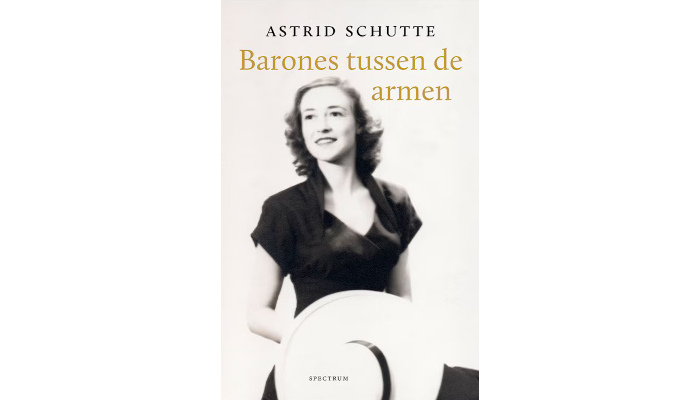
Astrid Schutte, a Dutch writer, recently published the first biography of de Vos, Barones tussen de armen (Baroness Among the Poor). Schutte consulted various sources, including members of de Vos’s family, former colleagues, and members of the ATD Fourth World movement. She also had access to correspondence and national archives. From this, she crafted a fascinating book on de Vos’s life, her family history, her parents and siblings, her childhood, youth, and education, her participation in the Dutch resistance during the World War II, her friends, her love life, her work as a diplomat, and her involvement in ATD Fourth World.
From 1971 onwards, first in the Netherlands and then as part of ATD Fourth World’s international relations team in France, I worked with Madame de Vos, as we called her. As a team, we drafted memos and organised meetings and gatherings. Together with Father Joseph, I accompanied her to numerous meetings with leaders of international institutions. But Madame de Vos was reticent about her personal life. We knew only bits and pieces.
Axelle Brodiez-Dolino’s study on the history of ATD Fourth World,1 describes Madame de Vos’s unique contribution to the development of ATD Fourth World but contains little information about her personal life.
In conversations with Pierre Dogneton2 for his book Ambassadrice auprès des plus pauvres (Ambassador to the Poorest People), Madame de Vos presents her vision of the ATD Fourth World movement. She highlights a number of important aspects of its history,3 but more as an interpreter of Father Joseph’s ideas than a proponent of her own
Schutte’s biography is different. It offers an understanding of how Madame de Vos’s life unfolded, the issues she faced, the initiatives she took, and the decisions she made. Schutte describes her as a courageous woman who gave up a comfortable life to devote herself to the most marginalised people, who made important choices and had a considerable influence on society. Schutte expresses her disappointment that so few people have heard of her.
In the first chapter of the book, Schutte describes how she was looking for a new subject when she came across a reference book4 edited by Els Kloek that featured biographies of 1,001 Dutch women, some of whom had been largely forgotten. It included a short text on Madame de Vos, which motivated Schutte to write her biography.
Working with Diplomacy to Overcome Poverty
Madame de Vos came from a privileged background. Her maternal grandfather was an adjutant at the court of the last German emperor, Wilhelm II. Her paternal grandfather served as president of the First Chamber of the States General in the Netherlands. She was born in the Netherlands in a villa near the sea in Noordwijk aan Zee. Her environment offered her protection. She spoke German with her mother, and she and her sisters had a Swiss nanny who spoke French. But she was socially isolated, being home schooled until secondary school, when her father finally allowed her to take the tram to Leiden. That was when she saw the reality of unemployed people, who had to report to the employment office every day to avoid losing their benefits.
Madame de Vos’s conversion to Catholicism and her work with Father Joseph marked a break with family tradition. She was one of the first Dutch women to join the diplomatic service, where women had previously not been welcome. Among the fifteen men and one other woman who took the entrance exam for the diplomatic service, she had the best results. Schutte’s book offers an insight into the work of Dutch embassies in Washington, Bonn, and Paris.
After meeting Father Joseph, Madame de Vos left her diplomatic career. Doing “good works” characterised the lives of many women of the nobility, but she was committed to bringing about structural changes in society. The new life she chose was not easy, and she received little support from her family and friends.
Madame de Vos knew where her strengths lay: making friends, building relationships, studying, writing notes, compiling files, negotiating, being diplomatic, and developing strategies. She was a pioneer in the field of research on extreme poverty, having organised several international colloquia at UNESCO in Paris in the 1960s. She attracted renowned sociologists such as Peter Townsend (United Kingdom), Lloyd Ohlin (United States), S. M. Miller (United States), Jules Klanfer (Austria), Henning Friis (Denmark), Jean Labbens (France), and Christian Debuyst (Belgium).
With Father Joseph and Volunteer Corps members to whom she passed on some tools of diplomacy, she met leaders of international institutions including the European Union, the Council of Europe, and the United Nations and its specialised agencies such as UNESCO, UNICEF, the International Labour Organization and the Office of the High Commissioner for Human Rights. Thanks to these efforts, extreme poverty is now internationally recognised as a human rights violation.5
Preserving the Legacy and Approach of Joseph Wresinski
Madame de Vos chose not to put herself in the spotlight, preferring instead to highlight Father Joseph and his approach. Not motivated by gender stereotypes, she stepped aside because she felt that, given Father Joseph’s childhood in poverty, the fundamental ideas he held and changes he was bringing about risked being hijacked by people of a higher social class, and that he and his work would be forgotten.
Schutte’s biography also touches on Father Joseph’s gift for attracting and inspiring collaborators from all walks of life. According to Madame de Vos, he knew how to convey to the people he met that it was impossible to end extreme poverty without people being fully committed to bridging the gap between those in deepest poverty and the rest of society.
For this reason, after Father Joseph’s death in February 1988, Madame de Vos pursued three objectives: to preserve his legacy and approach, to follow up on the Wresinski report of the French Economic and Social Council and to have the ATD Fourth World Volunteer Corps recognised as necessary to support the most marginalised people in their struggle for recognition and for the eradication of extreme poverty.
In particular, she laid the foundation for the Joseph Wresinski Archives and Research Centre in Baillet-en-France. She archived and published posthumous texts by Father Joseph and worked with colleagues on the Vatican’s beatification process for him.
In the late 1990s, when she was nearly 80 years old, she helped to create a theatre troupe in the Netherlands with and about people living in extreme poverty.
Reviews in Dutch national newspapers credited Schutte with writing an honest, well-researched, and readable biography.
Madame de Vos’s journey is exceptional. How could someone with such abilities, from such a privileged background, devote herself to a simple priest who worked alongside a deeply impoverished, excluded, and often despised population? Until the end, she strove to promote his experience and his approach and to preserve them for future generations.
- Axelle Brodiez-Dolino,: ATD Quart Monde, une histoire transnationale. La lutte contre la pauvreté, d’un bidonville à l’ONU (Paris, Presses universitaires de France/Humensis, 2025)
- Pierre Dogneton, Ambassadrice auprès des plus pauvres (Paris, l’Harmatan, 2001)
- James Jaboureck and Daniel Fayard gave a presentation on Dogneton’s book on 5 July 2011, on the occasion of the centenary of de Vos’ birth. (Centre de mémoire et de recherche Joseph Wresinski)
- Els Kloek: 1001 Vrouwen in de 20ste eeuw (Nijmegen, Vantilt, 2018)
- See: UN: Guiding principles on extreme poverty and human rights submitted by Special Rapporteur Magdalena Sepùlveda Carmona. (A/HRC/21/39 and A/HRC/21/L20, adopted on 27 September 2012)