


International Day for the Eradication of Poverty in Africa 2025
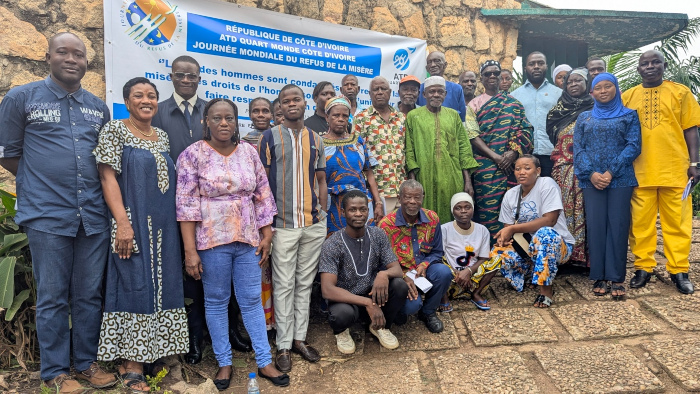
Above: The International Day for the Eradication of Poverty in Bouaké, Côte d’Ivoire
On October 17, 2025, ATD Fourth World members across Africa commemorated the International Day for the Eradication of Poverty, drawing widespread participation throughout the region.
Initiated by ATD Fourth World founder Joseph Wresinski, this day brings together people living in poverty and those who stand beside them in solidarity. It gives a voice to people who are too often unheard and reaffirms that human dignity should not be dependent on economic conditions or social status.
The theme this year was “Ending Social and Institutional Maltreatment”. The following accounts highlight key moments from events held in Africa.
Senegal: Denouncing silent injustice
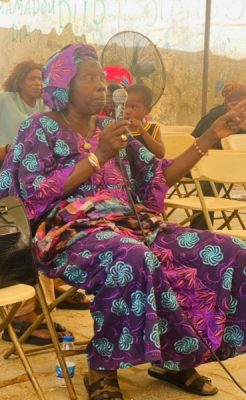 In Senegal, the commemoration took place in Guinaw-Rails (Pikine), a neighbourhood where ATD had been active in previous years1. ATD members Marcel Valéra and Sister Oumy Ndione live in the community, and Marcel proposed holding the event there. This provided an opportunity to reconnect with the community and revive ATD’s activities.
The event focused on one major issue: civil registration. The lack of registration remains one of the most insidious forms of social exclusion in Senegal. Thousands of people, both adults and children, often from families living in the most difficult circumstances, remain unregistered. In legal terms, they do not exist. Without identity documents, they cannot access basic rights such as education, health care, and employment. This lack of legal recognition is a form of institutional maltreatment. It weakens families, limits their opportunities for a better future, and can trap generations in poverty.
At the event, ATD Fourth World Senegal members denounced this silent injustice and shared their experiences and the barriers they face. They urged the authorities to reform civil registration processes and procedures.
El Hadj Omar Gueye, representing ATD Fourth World Senegal, reminded participants of October 17’s core message:
“[…] This day is to remind us that poverty is not inevitable.”
He emphasised that the lack of legal identity is a flagrant violation of human dignity, and invited all involved to join forces to bring this injustice to an end.
Malick Sall, a lawyer, raised concerns about the numerous administrative barriers that thousands of parents face. Birth registration must often happen within strict deadlines. For families in poverty, meeting these deadlines is often impossible due to limited transport options and work constraints. He called for more accessible and humane administrative processes. The ability to obtain identity papers should not depend on where someone is born; it should be available to all.
A Forum Theatre organised by the Kaddu Yaraax charity added an artistic dimension and encouraged active participation[Note]Forum Theatre is an educational tool that invites participants— “spect-actors”—to step into the performance, influence its course, and explore practical responses to social injustice and oppression.[/note].
The event was meaningful, giving participants a renewed sense of hope while reinforcing ATD Fourth World Senegal and its partners’ determination to continue raising awareness, supporting families, and advocating for change. The hope is that the right to legal identity will become a reality for everyone.
Burkina Faso: An invitation to work together
In Burkina Faso, October 17 events were held in three locations: Manéga, Méguet, and the ATD Courtyard of One Hundred Trades.
In Manéga, a gathering took place at the Dalle Africaine Sacrée (the Sacred African stone). Everyone involved also enjoyed a visit to the Manéga museum, where many were particularly moved to discover the Joseph Wresinski hut, which displays objects symbolic of ATD Fourth World.
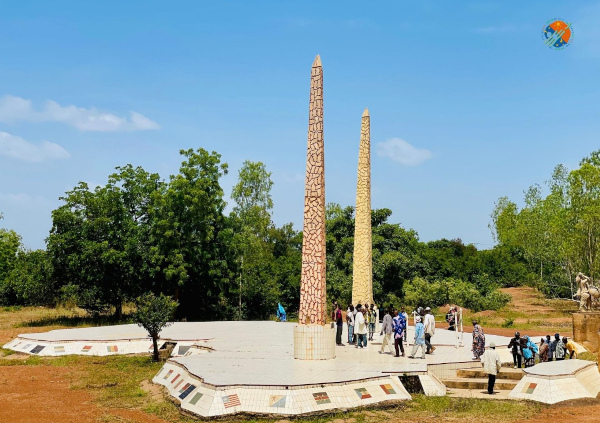
In Méguet, ATD Fourth World members visited the local health centre. They met patients and healthcare staff, offering words of comfort, encouragement, and hope.
In the Courtyard of One Hundred Trades, there were several speakers. Of particular note was the address by Nathalie Ouédraogo, representing the Ministry of Humanitarian Action and National Solidarity. She thanked ATD Fourth World for its significant contribution to the work to overcome poverty in Burkina Faso. She also called for solidarity and encouraged everyone to work together in promoting respect for human dignity.
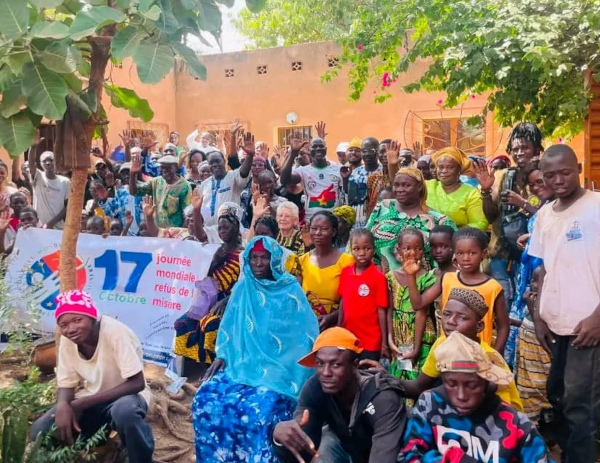
The Democratic Republic of the Congo (DRC): refusing to accept poverty in a climate of insecurity
In the DRC, members of ATD Fourth World held events on October 17 in Bukavu, Goma, and Uvira.
In Bukavu and Goma ATD Fourth World members organised a community awareness campaign. A radio programme featuring accounts and analysis of the causes and consequences of poverty posed the following question: “Is this day for the eradication of poverty still important in the context of insecurity that prevails in our country?”
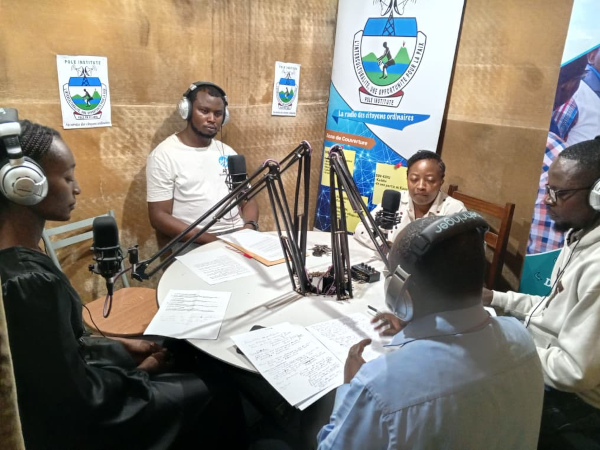
Volunteer Corps member Obedi Aganze responded: “Yes, it is very important, and especially so in a country which is dogged by insecurity and armed conflicts. It is an opportunity to draw attention to the fact that violence increases poverty, destroys families, and prevents communities from living in dignity. By commemorating this day, we are making an appeal for solidarity, for social justice, and for the reconstruction of a strong community spirit.”
In these two cities, ATD members conducted visits to families who had been displaced, disaster victims, the sick, and military and police personnel in vulnerable situations. Despite the challenges facing the country, these visits fostered a sense of solidarity and helped gather testimonials for advocacy work.
In Uvira, the day highlighted the need to combat social and institutional maltreatment. It also emphasised the importance of changing society’s view of poverty and the participation of people living in poverty in the decision-making process. The day was marked by gatherings, opportunities to share experiences, and speeches aimed at raising awareness and reminding people that poverty is not inevitable.
Jérôme Mutula, a young leader with the Tapori children’s group, outlined the key concepts underlying the day’s theme: “Ending Social and Institutional Maltreatment: Ensuring respect and appropriate support for families”:
- Ending maltreatment: Taking concrete action to eliminate the harmful reality of maltreatment.
- Social maltreatment: This refers to any practice or behaviour within public and private institutions that may humiliate, reject, or exclude people living in poverty (e.g., perpetuating discrimination or stigmatisation, failing to offer support or solidarity).
- Institutional maltreatment: This pertains to any practice or attitude exhibited within public and private institutions (hospitals, schools, administrative bodies) that excludes, delays, or restricts access to services for people living in poverty, treats them with contempt, or is involved in corrupt practices.
- Respecting families: Is recognising that every human being is worthy of respect, irrespective of their economic situation.
- Ensuring that families get the help they need: This means providing appropriate and equitable assistance, which is tailored to the real needs of families (and individuals) affected by poverty (e.g., facilitating access to education, healthcare, housing, or social support).
In Uvira, many families experience these challenges every day. Exclusion, feeling unheard, and insufficient or inaccessible services remain constant realities.
Côte d’Ivoire: Initiating Change through Dignity and Resistance
In Bouaké, Côte d’Ivoire, the International Day for the Eradication of Poverty was commemorated on 4, October 2025 at the House of Arts and the Family. The earlier date was chosen due to the country’s sensitive electoral context to ensure the event could take place peacefully.
The commemoration began with an overview of ATD Fourth World history in Côte d’Ivoire, which was founded by Sister Simone Viguié and young detainees facing difficult living conditions in Bouaké’s penal colony. This moment of remembrance reminded us that ATD Fourth World emerged from the dignity and resistance of people who had experienced poverty at its most extreme.
To respect security measures restricting large gatherings, participation was limited to about thirty people, including activists with lived experience of poverty, allies, volunteer corps members, and representatives of local organisations.
Despite the small number of attendees permitted, the discussions were powerful. The plenary sessions allowed several participants affected by social and institutional maltreatment to share deeply personal testimonials. One person stated,
“Social and institutional maltreatment is a reality that oppresses its victims and treats them like numbers. It stifles dreams and prevents talent from flourishing. How do we stop it? By providing universal access to education worldwide.”
Another participant added:
“We live in a world that is rich, but people still have to scavenge for food in dustbins. Even public institutions sometimes break their own rules. That only leads to more institutional maltreatment.”
These heartfelt exchanges reminded us that listening, showing solidarity, and respecting human dignity are extremely important in the work to overcome poverty.
In the Central African Republic: From sharing experiences to advocacy
In the Central African Republic, the commemoration took place in the courtyard of ATD Fourth World in Bangui and was moderated by Geoffroy Ngana, an ATD ally. On this day, we heard testimonials from several people:
Modestine: I have albinism. If you come from a family experiencing poverty you are denied your legal rights. At family gatherings, you are ignored, and it is difficult even to take part in the conversation. You never get any visits or help. One day, I asked myself how I could overcome poverty, and I eventually realised that it would have to be through my own efforts.
Matilingou Dieubeni: Often, handcart porters are no more respected than street children. But why? We get insulted all the time, but do people not see that it is by doing this job that we can pay the rent and meet the needs of our family?
Tanzania: Creating an environment that prioritises respect for human dignity
In Tanzania, the October 17 event took place in Dar es Salaam, at Kigamboni Hall in the Navy Beach Resort.
It brought together 200 participants from a variety of backgrounds, including families participating in ATD community programmes, representatives of national and international NGOs, community leaders, young activists, and many others. The goal of the event was to raise awareness and encourage dialogue on ending social and institutional maltreatment.
Dr Ave Maria Semakafu, a lecturer in gender studies, leadership and development, gave the opening address. She emphasised the importance of protecting human dignity at every level: family, community, and institutional. She encouraged collective action, advocacy, raising awareness, and creative initiatives to eliminate maltreatment and promote social justice.
Co-researchers from the “The Hidden Dimensions of Poverty” research project presented their findings. Drawing on the international study conducted between 2016 and 2019, they explained how hidden dimensions of poverty create additional barriers for those who are most vulnerable.
One testimonial that marked the day was from Peter Msasu, one of the founders of ATD Fourth World in Tanzania. After being falsely accused of murder by his cousin, he spent three years in detention, subjected to harsh treatment, and denied the right to mount a defence or appear in court. During that time, his family’s financial situation collapsed, and his children were particularly affected. They had to leave school because the family could no longer afford basic school supplies. Even now, after his release, his financial situation remains precarious.
Across Africa, these events highlight the importance of addressing social and institutional maltreatment. Listening, acting, and standing together are essential to ensure dignity for everyone. By amplifying the voices of people in poverty, ATD Fourth World members reaffirm that poverty is not inevitable and that lasting change must be built together.